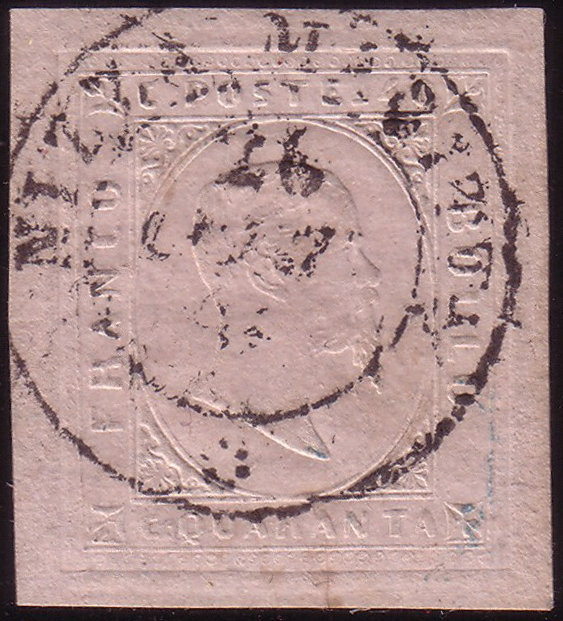
The context of the Sardinian postal reform
By the late 1840s, the Kingdom of Sardinia — which comprised Piedmont, Liguria, the island of Sardinia, and the Duchy of Savoy — was the most administratively modern of the Italian states. King Carlo Alberto's constitutional reforms of 1848 had produced a functioning parliament and a postal authority capable of adopting the British adhesive stamp system, patented by Rowland Hill in 1840, within little more than a decade of its introduction in the United Kingdom.
The first Sardinian stamps were issued on 1 January 1851. They were not the first adhesive stamps in the Italian peninsula — the Grand Duchy of Tuscany had issued its own stamps in April 1851 — but the Sardinian series would prove the most consequential: when the Kingdom of Italy was proclaimed in 1861, it was the Sardinian postal administration that absorbed all the others, and it was a modified version of the Sardinian design vocabulary that formed the basis of the first national Italian issue of 1862.
The 1851 first issue: denominations and design
The 1851 series comprised five denominations: 5 centesimi (black), 20 centesimi (blue), 40 centesimi (rose), and two 5-lire values for registered correspondence. The design was produced by the Officina Carte Valori in Turin. It featured the portrait of King Carlo Alberto in the centre of an unframed oval, surrounded by the inscription FRANCOBOLLO POSTALE and the denomination in words and figures.
The stamps were typographed — a printing method that placed the ink on raised surfaces, producing relatively consistent impressions but with occasional ink drag at the margins. They were imperforate, meaning that they had to be cut from the sheet by hand with scissors or a blade, which accounts for the wide variation in margin widths seen in surviving examples.

Sardinia 1854, Michel 8 — the second-issue stamp in revised colour on white paper. Image: Wikimedia Commons, public domain.
The 1853–1855 second issue
A revised second series was released between 1853 and 1855. The most significant change was the transition to a different paper stock — whiter, smoother, and more consistent — and revised colour shades to reduce postal counterfeiting. The 5-centesimi value, which had appeared in black on the first issue, was reissued in olive-green; the 20-centesimi value moved to a deeper indigo. The 1855 10-centesimi bistre value (Sassone No. 12) was a new denomination added to serve the rates introduced by the Franco-Sardinian postal convention of 1853.
The second-issue stamps were perforated from 1854 onward, with a gauge of approximately 12½. Imperforate examples of the second series are known but are exceptional and command significant premiums at auction. Collectors should be alert to genuinely imperforate stamps versus stamps with perforations trimmed away — a form of forgery known in Italian philatelic circles as dentellatura tagliata.
Postal use and cancellations
Sardinian stamps were cancelled at post offices across the territory by town-name handstamps, barred oval grills, and — in rural areas — manuscript pen cancellations. The most sought-after cancellations for the Sardinian series are those from the Crimean War campaign of 1855–1856, when a Sardinian expeditionary force of 18,000 men participated alongside French and British forces. Field post offices serving the army used identifiable cancel types, and stamps-on-cover from this campaign represent some of the rarest items in all of Italian postal history.
Equally prized are examples used in Lombardo-Venetia during the Second Italian War of Independence (1859), when Sardinian armies advanced into Austrian-held territory and Sardinian postal administration temporarily operated offices in Brescia, Bergamo, and Cremona. These brief usages — often lasting only weeks before the territories were absorbed into Sardinia by treaty — left a small number of documented covers that are intensively studied by specialist collectors.
Transition to the Kingdom of Italy
Following the proclamation of the Kingdom of Italy on 17 March 1861, Sardinian stamps remained valid for postage until 31 December 1862, when the first unified Italian issue fully superseded them. Sardinian stamps used during this transitional period — particularly on covers showing dual-era frankings — are an area of active study. The catalogue values in the Sassone guide differentiate sharply between stamps used before and after unification, with the latter commanding lower premiums because of the greater quantity that survived in commercial use.
The Sassone catalogue (published annually in Milan) remains the standard reference. For the 1851–1861 period, it lists the Sardinian issues as Nos. 1–16 of the pre-unification section. The Stanley Gibbons catalogue uses a parallel numbering system familiar to British collectors, and the Michel catalogue provides a third system used predominantly in German-speaking markets.
Where to study and acquire Sardinian material
Serious study of Sardinian philately benefits from access to the collections held at the Museo Nazionale della Filatelia in Rome, which holds reference collections from the national archive. The Federazione fra le Società Filateliche Italiane (FSFI) maintains a register of specialist dealers and expertization services.
At auction, Sardinian material regularly appears at Soranzo & Figli (Milan), Corinphila (Zurich), and Siegel Auction Galleries (New York). Unused examples of the rarer denominations — particularly the 1851 5-lire imperforate — regularly fetch five to six figures at major sales.