From monarchy to republic: the transitional issues of 1945–1947
Between the armistice of September 1943 and the constitutional referendum of June 1946, Italy was effectively in an interregnum for philatelic purposes. The Kingdom's stamps remained nominally in circulation while Allied Military Government overprints and provisional issues appeared in different parts of the country. The famous AMGOT (Allied Military Government of Occupied Territories) stamps, printed in the United States and distributed from 1943, are technically outside the mainstream of Italian philately but are keenly collected by specialists in occupation history.
The first stamps of the Italian Republic were issued in December 1945, before the formal vote — a series showing the Torch of Democracy. They were followed in 1946 by the first definitive series of the Republic, featuring the image of Italia Turrita (a personification of Italy as a crowned female figure, wearing a crown of towers) — a device that has appeared, in various artistic interpretations, on every Italian definitive series since.
The architecture of the Republic's commemorative programme
Italian commemorative stamps after 1946 fall into several recurring thematic categories that have remained consistent across governments of every political orientation:
- Art and cultural heritage — works in Italian museums and galleries, from Raphael to Caravaggio to twentieth-century painters, reproduced in photogravure with remarkable fidelity
- Architecture and archaeology — ancient Roman sites, medieval monuments, and Baroque and Renaissance buildings; a category tied to the broader political programme of heritage promotion
- Anniversaries of historical events — unification, the Risorgimento, the two World Wars, the Resistance, and the founding of the Republic itself
- Science and industry — notable Italians in physics, medicine, engineering, and exploration; the achievements of Italian industry in the postwar economic boom
- Sport — the Olympic Games (with Italy as host in 1960), the FIFA World Cup (Italy as host in 1934 and 1990), and cycling commemorating the Giro d'Italia
- European integration — from the Treaty of Rome (1957) onward, stamps marking milestones of what became the European Union
Notable series and single issues
Among the most studied single issues of the Republic period is the 1961 series commemorating the centenary of Italian unification. Issued in a set of twelve values with designs drawn from historical paintings and documents, it represents one of the most ambitious design commissions of postwar Italian philately. The photogravure printing by the Istituto Poligrafico dello Stato achieved a level of tonal range that distinguished it from the cruder recess-printing of earlier definitives.
The Rome Olympics issue of 1960 — timed to coincide with the first Olympic Games to be held in the Italian capital — produced a series of twelve values with clean photographic designs. These are among the most widely collected Italian stamps outside specialist circles, partly because of the global appeal of the Olympic theme and partly because they were produced in large print runs that have kept prices accessible.
At the other end of the scarcity spectrum, the Campioni del Lavoro (Champions of Labour) series of 1947 — issued in a single denomination in a print run significantly smaller than contemporary estimates suggested — has become one of the most discussed items of Republic-period philately, with genuine mint examples expertized by the FSFI commanding prices well above their nominal catalogue value.

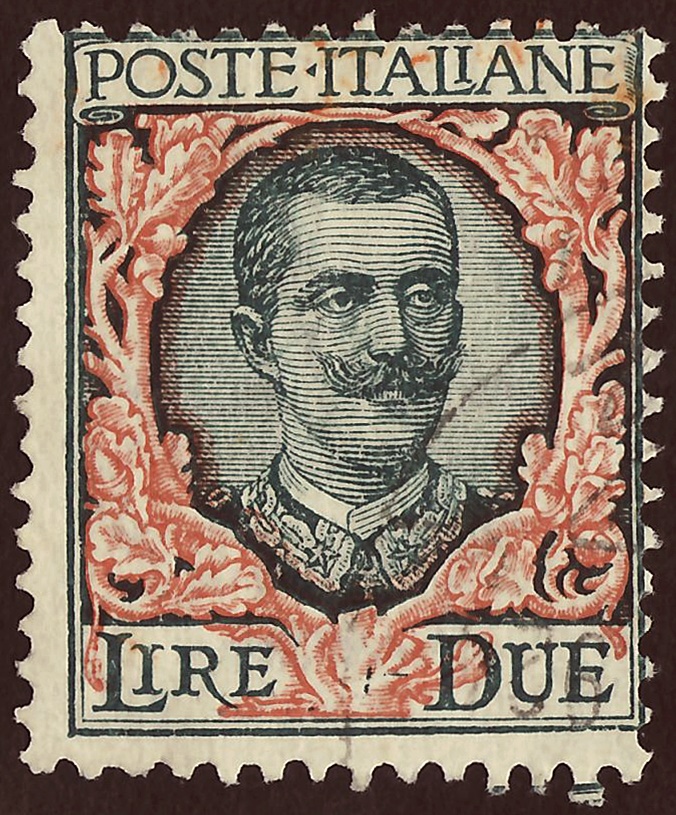
Italy 1924, 25 centesimi on piece with clear commercial cancel. This Kingdom-era issue predates the Republic but illustrates the continuity of Italian definitive design. Image: Wikimedia Commons, public domain.
Thematic collecting in the Republic period
Thematic philately — organizing a collection around a subject rather than a political period or country — has been particularly influential in Italy since the 1970s. The sheer volume of Italian commemoratives makes thematic collection both practical and rewarding. A collector interested in Italian Renaissance painting can assemble a multi-volume collection drawing on stamps issued over five decades without approaching the outer edge of the available material.
The Federazione Italiana Filatelia Tematica (FIFT), affiliated with the FSFI, maintains guidelines for thematic exhibitions and provides a framework for evaluating the philatelic versus thematic quality of a collection. At major Italian stamp exhibitions — particularly the biennial ITALIA series — thematic collections frequently outnumber traditional country collections in the competitive classes.
The Sassone catalogue and how to use it
The Sassone Catalogo Specializzato dei Francobolli d'Italia, published annually in Milan by Vaccari Srl, is the indispensable reference for all Italian stamps from 1851 to the present. It lists every issue with standard catalogue values in euros for mint (with original gum) and used (with clean datestamp cancel) examples. The catalogue also lists official maximum values for expertized varieties, and the annual edition updates auction results from the preceding year.
One important note for non-Italian collectors: Sassone values are quoted at a standard that assumes fine condition — well-centred, full perforations, bright colours. The difference in market value between a fine example and a poor one can be substantial, particularly for the pre-1950 material. The catalogue's preface section provides detailed grading criteria that are worth reading carefully before using the values as a buying or selling guide.
Definitives of the Republic: the overlooked counterpart
Alongside the commemorative programme, Italian definitives since 1946 have followed their own evolution. The Italia Turrita theme has been redrawn multiple times, and each iteration — 1945, 1955, 1968, 1979, and subsequent updates — constitutes a distinct series with its own paper, perforation, and printing variants. Some of these definitives are found in very high face values used on parcel post and registered mail, and examples on complete parcel cards are much sought after by postal history specialists.
The transition to Euro-denominated stamps in 2002 prompted another redesign, and since then the definitive series has been supplemented by self-adhesive and coil formats alongside traditional gummed sheets. These modern formats are catalogued in Sassone but attract less specialist attention than the earlier material.